About
Important
This work is directly related to the study [Schott2023] and [Schott20232]. This project is under construction and new functionalities are constantly added on this package.
For support do not hesitate to contact Florian Schott or Rajmund Mokso
Overview
The package is currently structured in 11 sections:
FoamQuant.Process
FoamQuant.FromBinary
FoamQuant.FromLabelled
FoamQuant.FromContact
FoamQuant.Tracking
FoamQuant.Passage
FoamQuant.Average
FoamQuant.Figure
FoamQuant.Movie
FoamQuant.VTK
FoamQuant.Helper
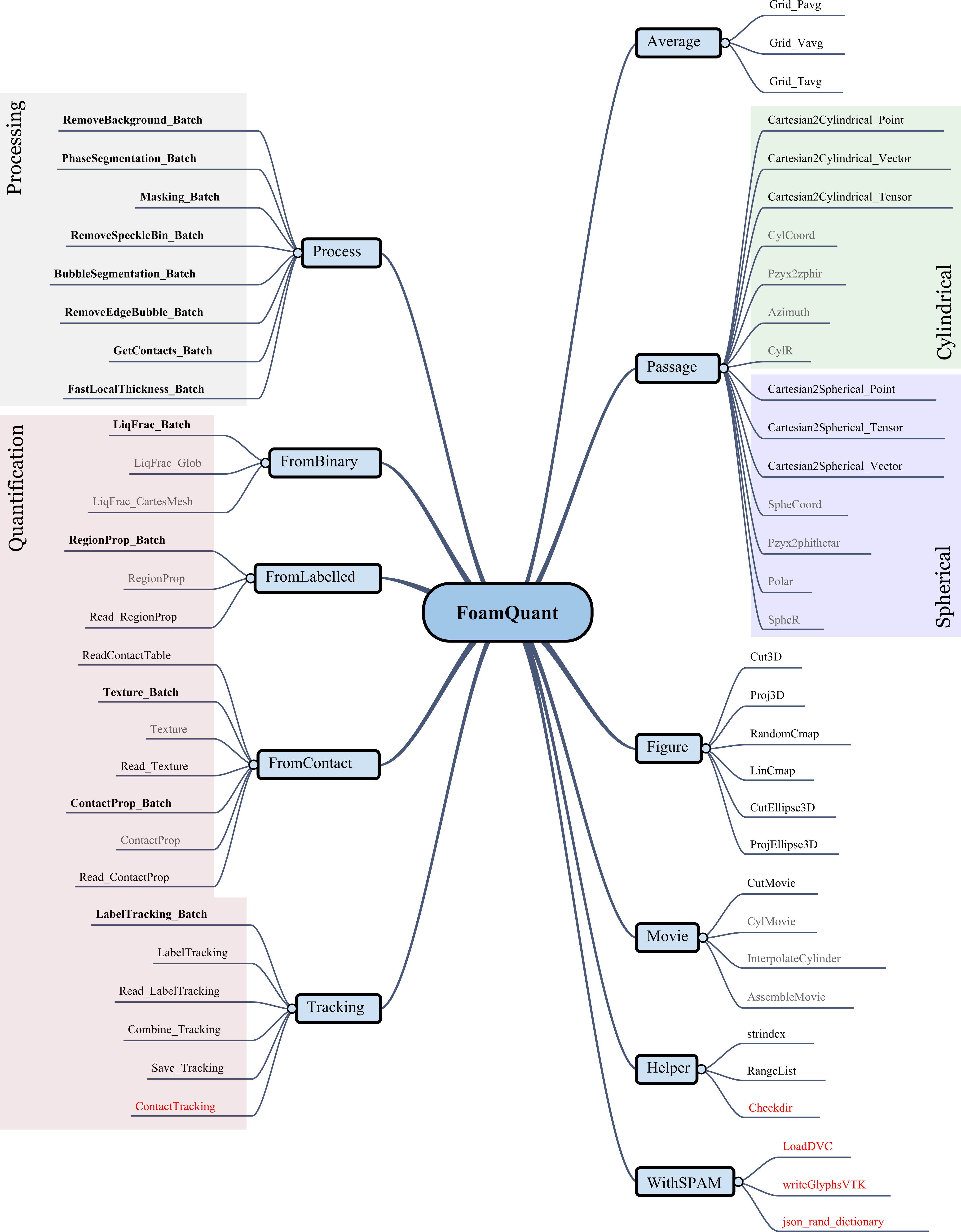
Current package structure. The functions in red are not yet included in FoamQuant.
Process
Wrapped functions for processing batch foam-like images: from raw images to bubble-segmented images.
Remove background (homogeneization)
Phase segmentation (binarization)
Masking (cylindrical or region of interest)
Remove small objects and holes (volume threshold)
Bubble segmentation (watershed)
Remove edge bubbles (edge of a mask if provided)
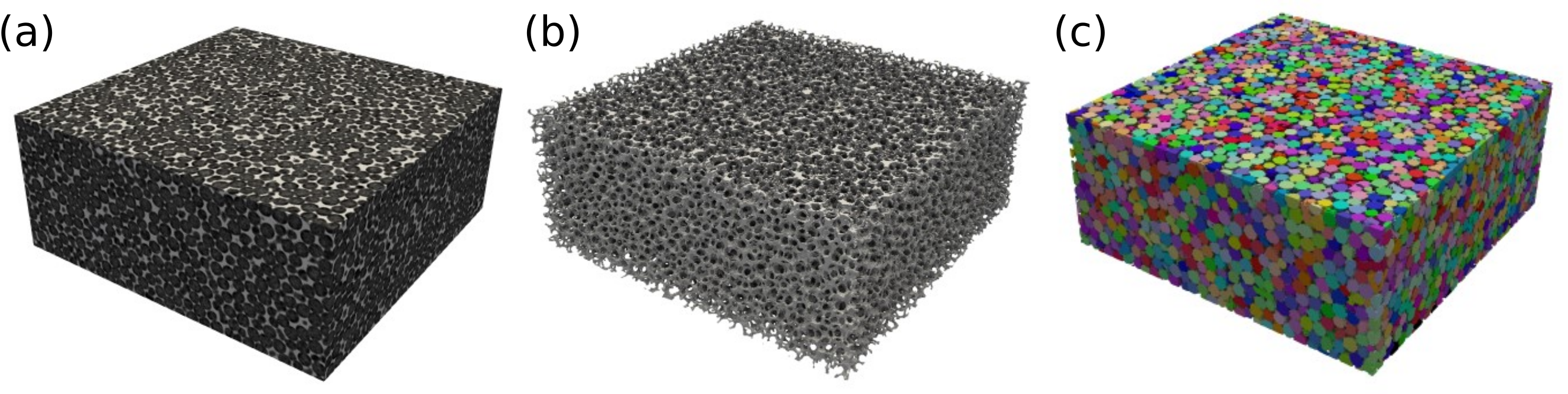
raw reconstructed image, (b) phase segmented image and (c) bubble segmented image.
FromBinary
Functions to quantify the liquid fraction from a batch of phase segmented images.
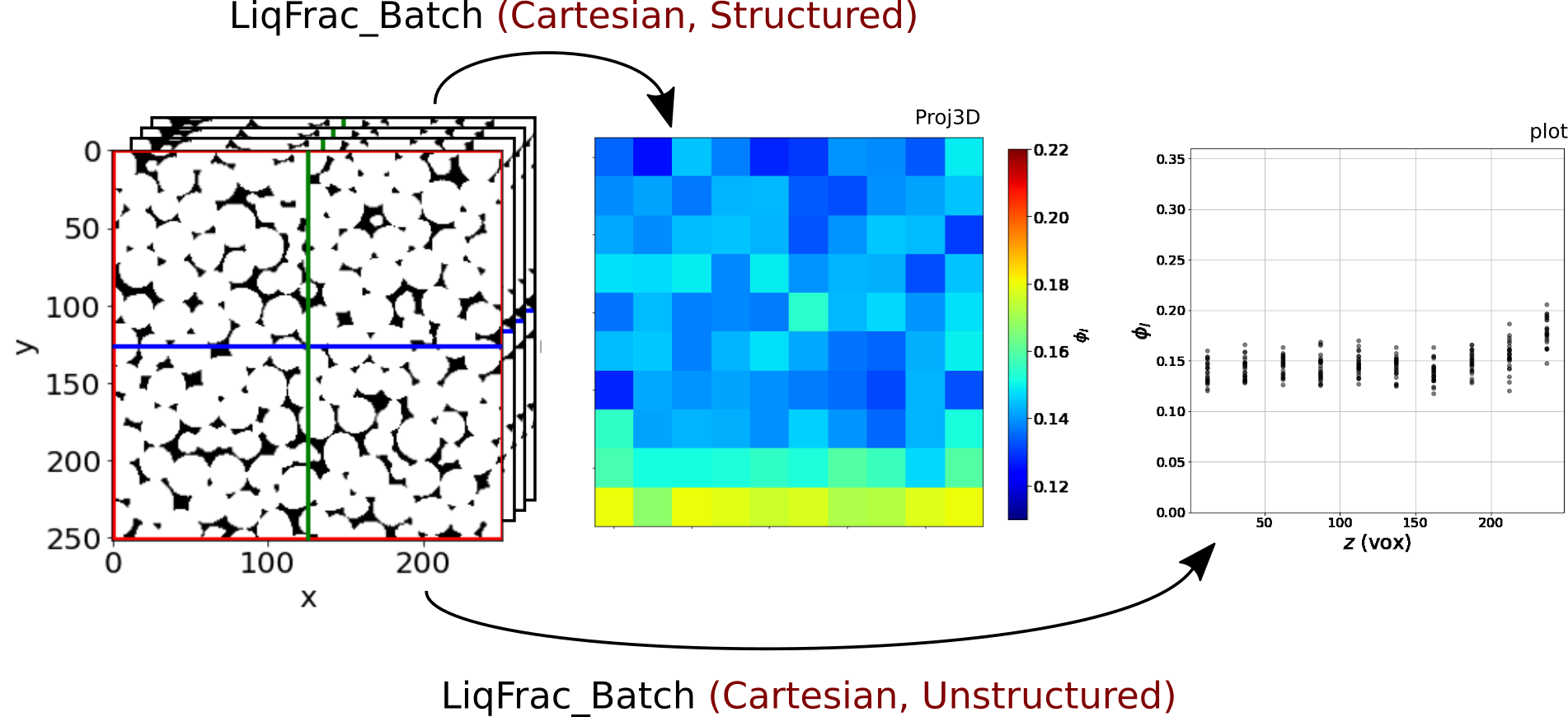
The liquid fraction along a cartesian mesh can be returned structured or unstructured.
FromLabelled
Functions to quantify the bubbles regions properties from a batch of labelled images.
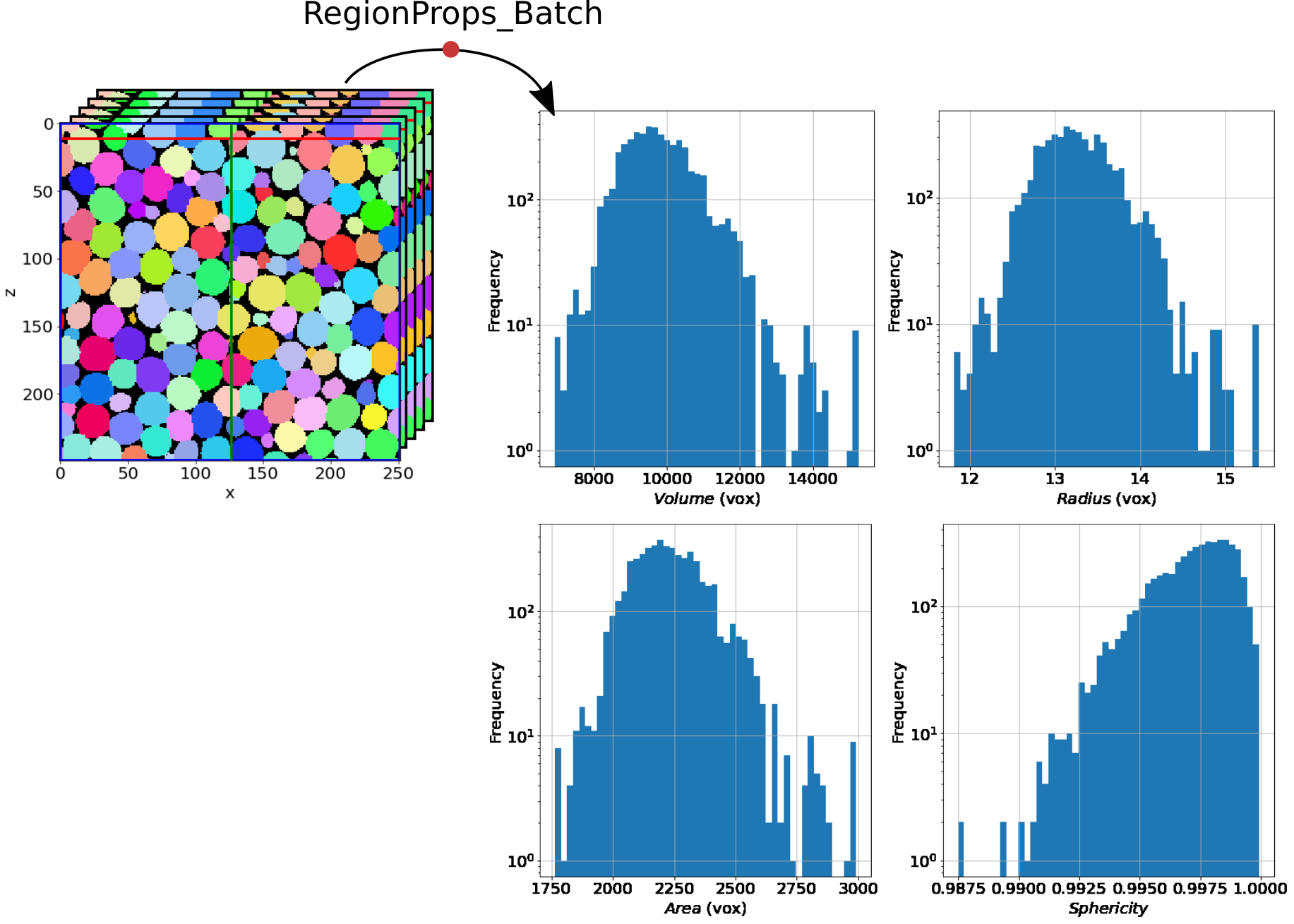
The function save the regions properties in a .csv
Tracking
Functions to track the bubbles and their properties from a batch of labelled images.
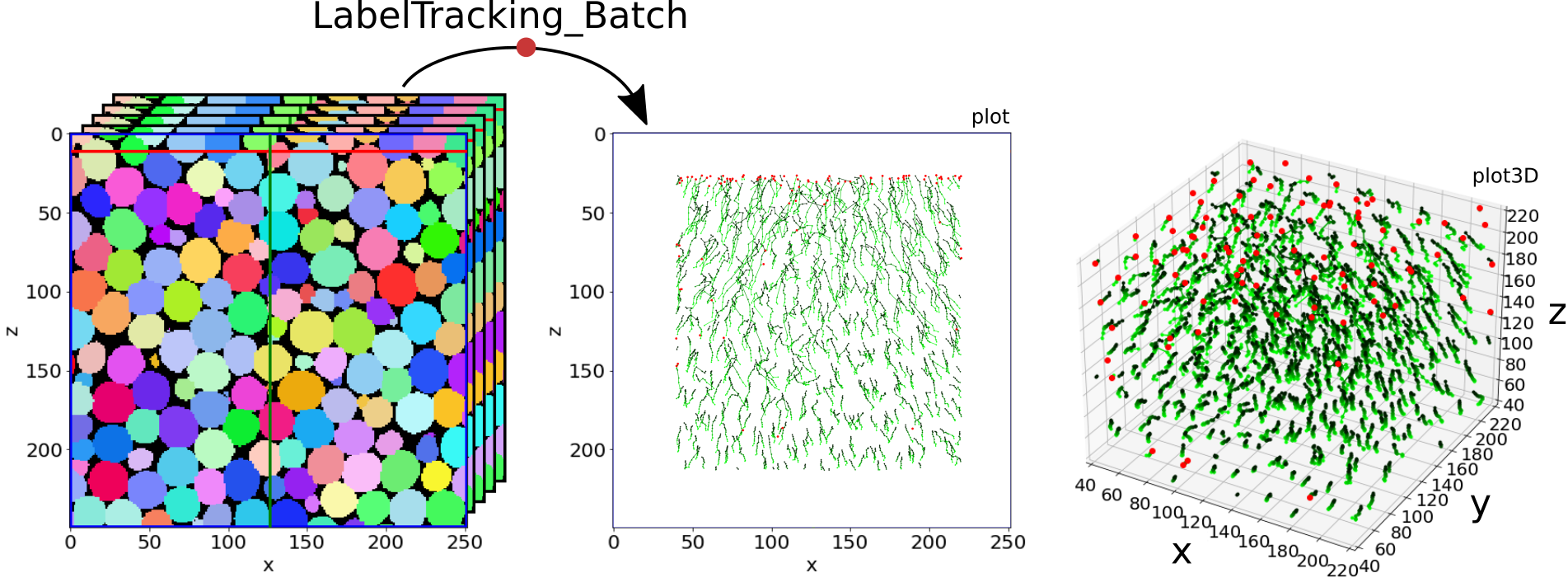
The color (from green to black) indicates the time index. The red points are the lost tracking positions.
Passage and Average
Functions to convert scalar, vectorial or tensorial properties from cartesian to cylindrical and spherical, and perform time/space averages.
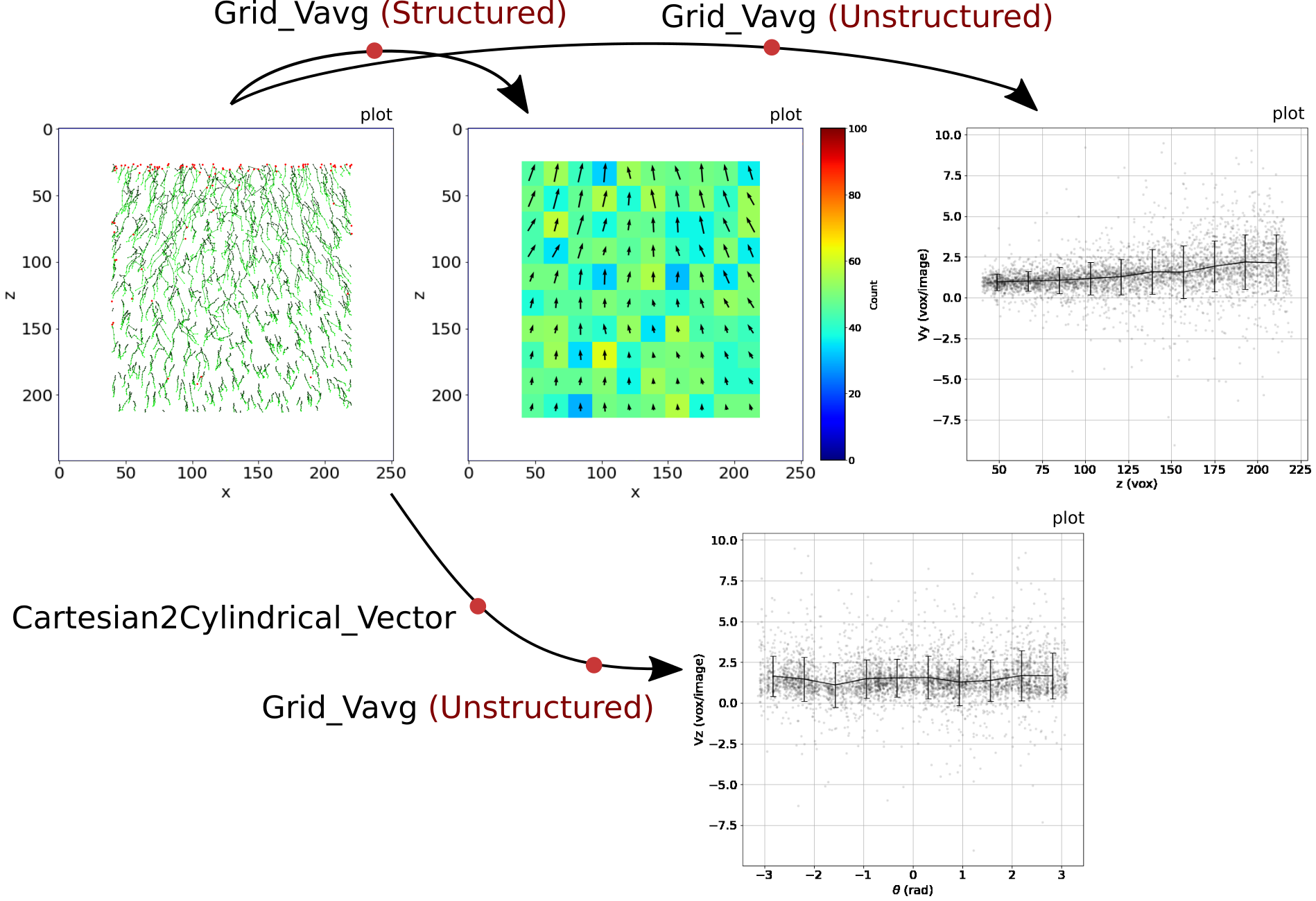
In this example the displacement field is first expressed in a cylindrical basic and then averaged.
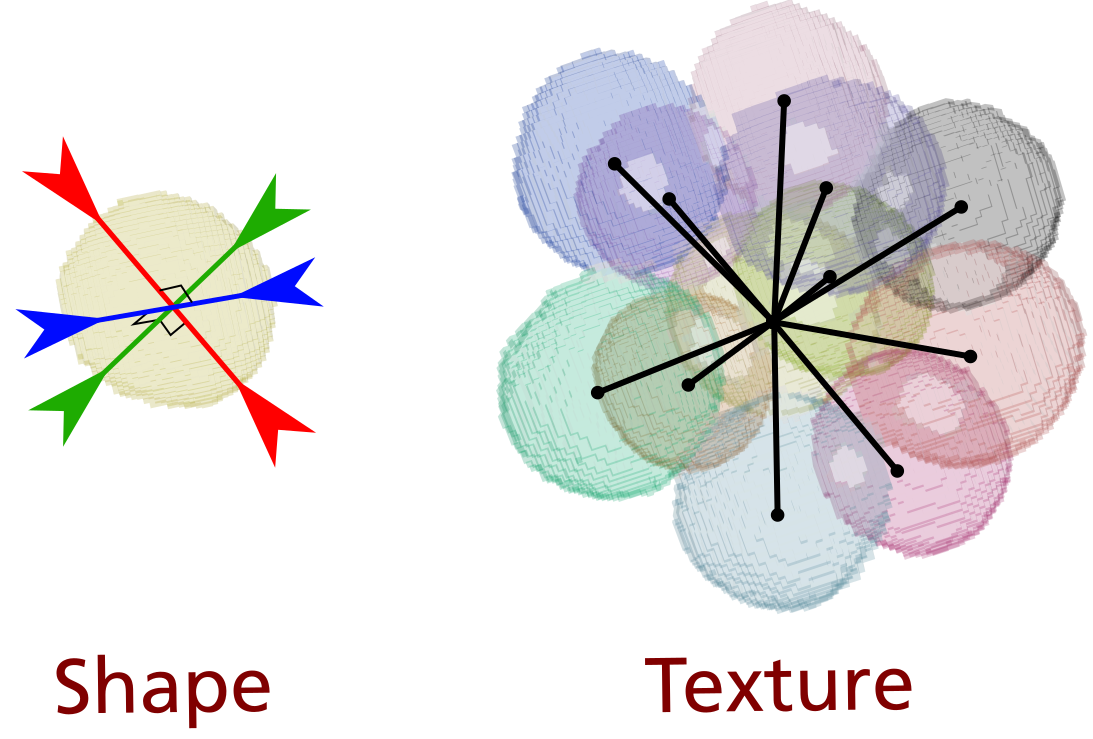
Two ways of measuring the internal strain field
Shape field, defined in [Graner2008] and first used in [Raufaste2015]
Texture field, defined in [Graner2008]
Label traking
The tracking method was inspired by ID-track presented in [Ando2013].
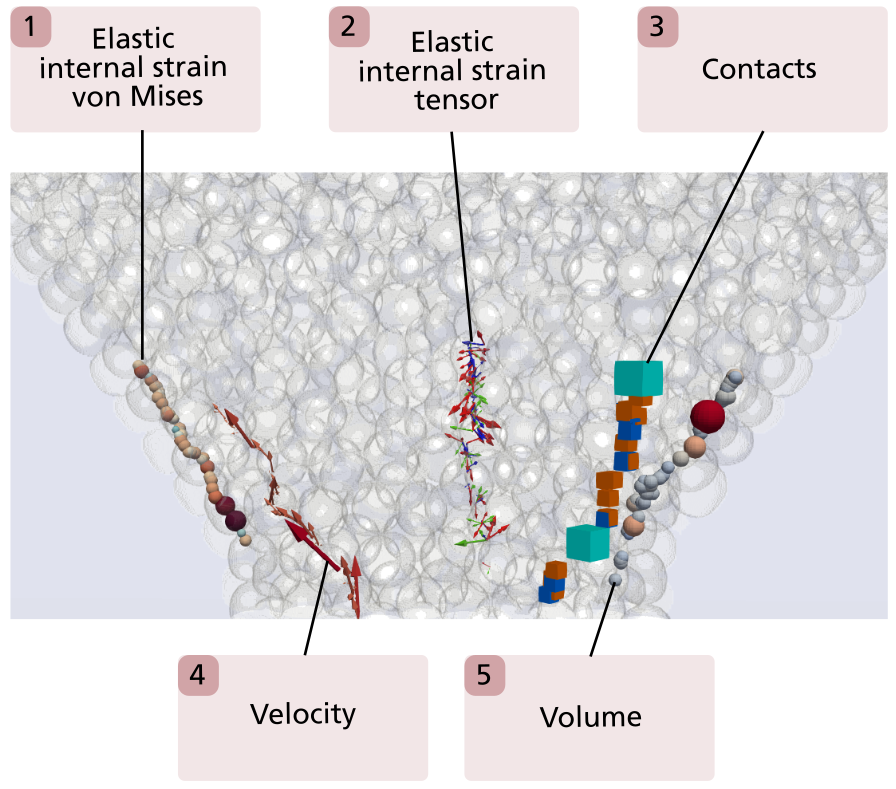
Tracking of five bubbles, showing various tracked properties: elastic internal strain, number of neighbours, velocity, and volume.
References
van der Walt et al., scikit-image: Image processing in Python. PeerJ 2:e453 (2014) https://doi.org/10.7717/peerj.453
Stamati et al., (2020). spam: Software for Practical Analysis of Materials. Journal of Open Source Software, 5(51), 2286, https://doi.org/10.21105/joss.02286
Andò,E. et al., Experimental micromechanics: grain-scale observation of sand deformation, Géotechnique Letters 2, 107–112, (2012) https://doi.org/10.1680/geolett.12.00027
Hall et al., Discrete and continuum analysis of localised deformation in sand using X-ray μCT and volumetric digital image correlation. Géotechnique, 60(5), 315-322, (2010) https://doi.org/10.1680/geot.2010.60.5.315
Graner et al., Discrete rearranging disordered patterns, part I: Robust statistical tools in two or three dimensions, Eur. Phys. J. E 25, 349–369 (2008) https://doi.org/10.1140/epje/i2007-10298-8
Raufaste, C. et al., Three-dimensional foam flow resolved by fast X-ray tomographic microscopy, EPL, 111, 38004, (2015) https://doi.org/10.1209/0295-5075/111/38004
Schott et al., Three-dimensional liquid foam flow through a hopper resolved by fast X-ray microtomography, Soft Matter, (2023) https://doi.org/10.1039/d2sm01299e
Schott et al., Structural formation during bread baking in a combined microwave-convective oven determined by sub-second in-situ synchrotron X-ray microtomography, Food Research International, (2023) https://doi.org/10.1016/j.foodres.2023.113283